There are also versions for voice and string quartet (Youtube: https://youtu.be/Tdszwm08EMI), for voice and piano, for piano solo (simplified version), and several settings for wind or string instruments and piano.
Author: Eduard de Boer
Vier Stukken voor Viool en Piano (Four Pieces for Violin and Piano), Op. 1
- Prelude
- Scherzo
- Forbidden Romance attacca:
- Toccata
Dedicated to Sander Hesselink (I), Saskia Moerenhout (II), Yvonne Franssen (III) and Pavel Sorm (IV)
Youtube (Forbidden Romance & Toccata):
Liza Ferschtmann, violin: Mireille Heijltjes, piano
Ponte dei Sospiri (Bridge of Sighs). Version for Violin and Piano
There are also versions for piano solo (Youtube: https://www.youtube.com/watch?v=tH8kA8ML_eI), for flute and piano and for cello and piano.
Ponte dei Sospiri (Bridge of Sighs). Version for Flute and Piano
There are also versions for piano solo (Youtube: https://www.youtube.com/watch?v=tH8kA8ML_eI), for violin and piano and for cello and piano.
From: 3 Preludes. Version for Wind Orchestra of Nrs. I and II, Op. 73a
I. Prelude to St. Cecilia
Commissioned by Jo Boers
II. Prelude to a New Era
Dedicated to Sabine MacNeill
Originally composed for fanfare orchestra (Youtube: https://www.youtube.com/watch?v=fX1tzHIae8A & https://www.youtube.com/watch?v=DxEAY5darqw).
Varen (Sailing), Folk-like Song from the Opera De Russenoorlog, Op. 49. Arr. for Cello and Piano
There are also versions for voice and string quartet (Youtube: https://youtu.be/Tdszwm08EMI), for voice and piano, for piano solo (simplified version), and several settings for wind or string instruments and piano.
Audita Tremendi, Op. 72
Audita Tremendi is the title of a papal bull issued by Pope Gregory VIII on October 29, 1187. It was written in response to the utter defeat of the Kingdom of Jerusalem at the Battle of Hattin on July the 4th of that year and the capture of the ‘True Cross’ (a piece of wood at the time believed to be from the cross upon which Jesus was crucified) by Saladin’s Muslim armies. Its title consists of the first two words of the text, which begins as follows:
Audita tremendi severitate iudicii, Having heard of the severity of the awesome judgment
quod super terram Hierusalem that over the land of Jerusalem
divina manus exercuit, the divine hand exercised,
tanto sumus nos et fratri nostri horrore confusi, by such a horror were we and our brothers disturbed,
tantisque afflicti doloribus, and afflicted by such sorrows,
ut non facile nobis occureret, quid agere, that it did not easily come to our minds what to do
aut quid facere deberemus, or what we should do,
nisi quod Psalmista deplorat et dicit: save that the Psalmist laments and says:
Deus, venerunt gentes in haereditatem tuam, ‘O God, the Gentiles have come unto your inheritance,
coinquinaverunt templum sanctum tuam; they have contaminated your holy temple,
posuerunt lerusalem in pomorum custodiam; they have laid waste Jerusalem;
carnes sanctorum tuorum they have left [the dead bodies of] your Saints as meat
bestiis terrae et escas volatilibus coeli etc. for the beasts of the earth and food for the birds of the air…’
[Ps. 78:1–2] [Ps. 78:1–2]
The bull is a passionate plea for a new crusade, and the eventual result became known as the Third Crusade, with Richard the Lionheart, Philip Augustus and Saladin as the most famous protagonists. The intensity of both the text and of the events that had preceded it and were to follow inspired me to dedicate a composition to this subject. It has become a composition in four continuous movements:
I. Turba (Turbulence)
The news that a large majority of Crusader forces was killed or captured during the Battle of Hattin results in chaos and turbulence, everywhere in Europe. This initially turns to grief.
II. Crucifigat Omnes (May all of them be crucified)
Now grief has turned to anger and lust for revenge. The Medieval song Crucifigat Omnes – part of the Carmina Burana collection – is an example of the atmosphere that pervaded Europe during the times of the Third Crusade. Here are the first and the last lines:
Crucifigat omnes May crucify them all
Domini crux altera, the Lord’s second cross,
nova Christi vulnera! Christ’s new wounds!
Arbor salutifera The Tree of Healing [‘True Cross’]
perditur; sepulcrum has gone lost. The grave
gens evertit extera has been destroyed by a foreign people
violente. Plena gente by force. Once full of people,
sola sedet civitas. the city now lies destitute.
(…) (…)
Suda martyr in agone Go sweat as a martyr in struggle,
spe mercedis et corone! in hope of reward and crown!
derelicta Babylone Leave behind Babylon
pugna and fight
pro celesti regione, for the heavenly region,
aqua vite! te compone for the water of life! Adjust yourself
pugna! by fighting!
The second time the melody of this song appears, it is merged with march-like music, that ultimately takes over, symbolizing a march all the way to the ‘Holy Land’. Finally, the port of Acre is reached and Saladin’s forces are awaiting the Crusaders.
III. Praelium (Battle)
Depicting the Battle of Acre, in October 1189, during which the Christian forces endured heavy losses, but which did not end in a decisive victory for any of the parties. The ensuing Siege of Acre lasted almost two years and was horror beyond imagination. Especially during the winter of 1190, where thousands of Christians died, due to lack of nutrition and large-scale epidemics:
IV. Hiemali Tempore (In Winter Time)
Scenes of mournful desolation alternate with music depicting gradually increasing frenzy. The melody from the medieval song Hiemali Tempore, also from the Carmina Burana collection, forms the basis of this movement. Towards the end, there is a ray of hope amidst all the sorrow and grief: a glimmer of hope that the day will come that there will be no more violence and hatred, both in the ‘Holy Land’ and elsewhere. But then frenzy takes over again, bringing the composition to an energetic conclusion.
Ave Maria. Version for Soprano, Mezzo or Alto and Two Pianos
Dedicated to Maaike
There are also versions for high voice and piano, for medium or low voice and piano, for soprano, mezzo or alto and piano, for soprano, mezzo or alto and piano four hands, for soprano, mezzo or alto and wind orchestra, and for two flugelhorns and wind orchestra.
Ave Maria. Version for Soprano, Mezzo or Alto and Piano Four Hands
Dedicated to Maaike
There are also versions for high voice and piano, for medium or low voice and piano, for soprano, mezzo or alto and piano, for soprano, mezzo or alto and two pianos, for soprano, mezzo or alto and wind orchestra, and for two flugelhorns and wind orchestra.
Ave Maria. Version for Soprano, Mezzo or Alto and Wind Orchestra
Dedicated to Maaike
There are also versions for high voice and piano, for medium or low voice and piano, for soprano, mezzo or alto and piano, for soprano, mezzo or alto and piano four hands, for soprano, mezzo or alto and two pianos, and for two flugelhorns and wind orchestra.
Amara tanta Tyri, for Two Pianos and Wind Orchestra, Op. 84
I. Discedite! attacca:
II. Pax Omnipotens
 Commissioned by the Dutch Fund for the Podium Arts
Dedicated to the piano duo Stefan and Martijn Blaak
Several years ago, the brothers and piano duo Stefan and Martijn Blaak suggested me to write a composition for them for two pianos and symphonic wind orchestra. Eventually, this resulted in a benign grant with the euphonious title Werkbijdrage Muziekauteur (Work Contribution Music Author) from the Dutch Fonds voor de Podiumkunsten (Fund for the Podium Arts).
The starting point for the composition is the tenth song from my choral song cycle Cantica Aviditatis (Songs of Greed), a song called Amara Tanta Tyri. This title is an ancient exorcism spell, allegedly with the power to expel demons. Not only did the thought appeal to me to compose a piece in the vein of Schubert’s Wanderer Fantasie – in other words, a song as a point of departure for an instrumental work – but besides this, the concept of expelling evil from the world has been a source of inspiration for me for several years now. To give one telling example of evil existing in the present-day world: fortunately, many people are aware now that the official 9-11 story can’t possibly be true, and the idea that a small group of wealthy and powerful people actually have been able to concoct such an evil plan, to have it executed, to blame the attacks on innocent people that had nothing to do with it, to somehow create the illusion that there would be some sort of relationship with Saddam Hussein and Iraq, subsequently to go to war with this country, thereby making the perpetrators even more wealthy and powerful, while at the same time manipulating the world population into thinking that the laws that have come into effect as a result of their evildoing could solve any of the problems that were created by the wealthy and mighty criminals in the first place; all this is mind-boggling almost beyond comprehension. And so is the realisation that the evildoers are still walking free today, having all the freedom and resources in the world to concoct yet more evil schemes. And indeed from here it is only a small step to things like dark secret societies, satanic ritual abuse, etc. Anyway, the lighter side of all this (if you can call it that) is that it is a goldmine of inspiration of the darker type, at least for me.
The act of expelling such unspeakable evil reminds me of the ultimate battle between light and dark in what is described as the end times in the biblical Book of Revelation. I chose the following quotes from its 20th Chapter as mottos for the two movements of the composition:
| EX APOCALYPSIS IOANNIS, Caput 20
I. Discedite! 1. Et vidi angelum II. Pax Omnipotens 6. Beatus et sanctus, |
FROM THE APOCALYPS OF JOHN, Chapter 20
I. Disappear! 1. And I saw an angel II. Peace Almighty 6. Blessed and holy |
Unsurprisingly, the first movement describes a battle between dark and light. The thematic material comes from the abovementioned song from the Cantica Aviditatis cycle, complemented by an ominous sounding rendition of the dies irae plainchant, and the melody of the first Cantica Aviditatis song, where the demonic power of Babylonian money magic is the central theme. At the end of the movement, one hears the crumbling of the satanic power structures, leading to their demise at the start of the second movement. Here, we encounter the very same themes as in the first movement, but metamorphosed into music that now sounds peaceful and harmonious – even the dies irae melody – while gradually growing in strength, all the way to the triumphant ending of the composition.
Also the formal structure of both movements is similar: an exposition of the musical material is followed by an expanded version of the same. In the first movement, this expanded version can be subdivided into a repetition of the exposition, now for pianos and orchestra (rehearsal numbers 4 to 7), a development section (numbers 8 to 17) and a reprise with coda (numbers 20 to 24). In the second movement, the expanded repetition of the material (starting at rehearsal number 30) doesn’t allow for such a subdivision, because of the serenity of the overall atmosphere. In order not to disturb this atmosphere, the structure has been kept very simple, like in the generally peaceful last movement of Beethoven’s last piano sonata, opus 111.
Eduard de Boer, March 23, 2018
Devil’s Dance. Version for Euphonium and Piano
Inspired by the Norwegian Folk Melody Fanitullen
Youtube:
David Thornton, euphonium: Ruth Webb, piano
There are also versions for euphonium and wind band (Youtube: https://www.youtube.com/watch?v=GW-uFpNaOw8), for euphonium and brass band (Youtube: http://www.youtube.com/watch?v=b2gqvE0S5AE) (excerpts), for E flat tuba, the brass ensemble of a wind band and percussion (Youtube: http://www.youtube.com/watch?v=iQ4oA6PIoHU) and for E flat tuba and brass band.
Devil’s Dance. Version for Euphonium and Brass Band
Inspired by the Norwegian Folk Melody Fanitullen
Youtube (excerpts):
Robbert Vos, euphonium: Brass Band Schoonhoven conducted by Erik Janssen
There are also versions for euphonium and wind band (Youtube: https://www.youtube.com/watch?v=GW-uFpNaOw8), for euphonium and piano (Youtube: http://www.youtube.com/watch?v=39KK9Lt31rk), for E flat tuba, the brass ensemble of a wind band and percussion (Youtube: http://www.youtube.com/watch?v=iQ4oA6PIoHU) and for E flat tuba and brass band.
Devil’s Dance. Version for E Flat Tuba and Piano
Inspired by the Norwegian Folk Melody Fanitullen
There are also versions for E flat tuba, the brass ensemble of a wind band and percussion (Youtube: http://www.youtube.com/watch?v=iQ4oA6PIoHU), for E flat tuba and brass band, for euphonium and wind band (Youtube: https://www.youtube.com/watch?v=GW-uFpNaOw8), for euphonium and brass band (Youtube: http://www.youtube.com/watch?v=b2gqvE0S5AE) (excerpts) and for euphonium and piano (Youtube: http://www.youtube.com/watch?v=39KK9Lt31rk).
Devil’s Dance. Version for E Flat Tuba and Brass Band
Inspired by the Norwegian Folk Melody Fanitullen
There are also versions for E flat tuba, the brass ensemble of a wind band and percussion (Youtube: http://www.youtube.com/watch?v=iQ4oA6PIoHU), for E flat tuba and brass band, for euphonium and wind band (Youtube: https://www.youtube.com/watch?v=GW-uFpNaOw8), for euphonium and brass band (Youtube: http://www.youtube.com/watch?v=b2gqvE0S5AE) (excerpts) and for euphonium and piano (Youtube: http://www.youtube.com/watch?v=39KK9Lt31rk).
March of Iskahdar – Khan. Version for Fanfare Orchestra, Op. 81
So far co-commissioned by[1]:
- Johan Jansen and Eline van den Bos
- Fanfare Orchestra ‘Concordia’, Meterik and their conductor Chris Derikx
- Thom Zigterman
- Fanfare orchestra Emergo, Castricum and their conductor Erik van de Kolk
- Gelders Fanfare Orkest
There is also a version for wind orchestra, op. 81a.
[1] This composition is a crowdfunding project. I also wrote a version of it for standard wind orchestra, and for € 250, you and / or your orchestra can become one of the commissioners of either version: you will then receive PDF material of the score and the parts, my trust that you will not distribute this material, and you will also be mentioned in this preface to the score as a co-commissioner. If you feel like participating, please contact me at hallo[at]eduarddeboer.org.
Coming to Light. Version for Brass Band, Op. 68 bis
Dedicated to Alisa and Gabriel Dearman
There is also a version for wind orchestra, Op. 68 (Youtube: http://www.youtube.com/watch?v=nBod6sVmYUY&t=813s).
There is also an abridged version for brassband, called Coming to Light Shortly. An impression of this version, in the form of a performance of the version for wind band with cut, can be heard here:
Youtube:
Psalm 91 (Choral) from the opera De Russenoorlog, Op. 49. Version for Fanfare Orchestra
There is also a version for wind orchestra and also one for mixed chorus a capella.
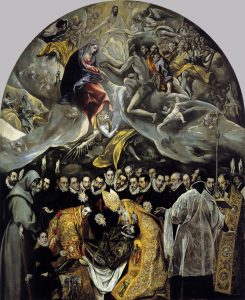
El Entierro del Conde de Orgaz (The Burial of the Count of Orgaz), after El Greco’s Painting, Op. 70
Commissioned by the Concejalía de Cultura del Excmo. Ayuntamiento de Yecla and the Museo de Réplicas del Greco Regreco 400
Dedicated to Ángel Hernández Azorín and the Banda “Asociación Amigos de la Música” de Yecla
This composition is the result of a joint commission by the Concejalía de Cultura del Excmo. Ayuntamiento de Yecla and the Museo de Réplicas del Greco Regreco 400 to write a piece after El Greco’s wonderful painting El Entierro del Conde de Orgaz (The Burial of the Count of Orgaz), to be performed by the Banda “Asociación Amigos de la Música” de Yecla and their conductor Ángel Hernández Azorín, in the year 2014, the fourth centenary of the painter’s death. I feel very grateful to have been entrusted with a commission with such spiritual significance and I have tried my best to compose a piece worthy of the occasion, the painter and the painting.
The painting itself depicts a miracle that allegedly took place in 1312. In that year, a certain Don Gonzalo Ruíz, native of Toledo, and Señor of the town of Orgaz, passed away. He was a pious man and a philanthropist, who, among other charitable acts, left a sum of money for the enlargement and adornment of the church of Santo Tomé (El Greco’s parish church). According to the legend, at the time of his burial, Saint Stephen and Saint Augustine descended in person from the heavens and buried him by their own hands in front of the dazzled eyes of those present.
A number of Gregorian melodies have been used to represent various personages on the painting, as will be explained in detail below. A number of players are meant to play these melodies offstage, from a more or less high position, in accordance with the level in which they are depicted on the painting. The composition’s structure is as follows:
I. Himno (Hymn)
A jubilant Introduction, marvelling at the miracle depicted in the painting as a whole, based on the Latin words Magna et mirabilia opera tua, Domine Deus omnipotens (Great and marvellous are your works, Lord God Almighty!
II. Cortejo Fúnebre (Funeral Procession)
This movement deals with the painting’s lower part. A mourning crowd is accompanying Don Gonzalo Ruíz to his last resting place. A funeral procession melody, somewhat in the vein of Spanish Renaissance music, is alternated with the Gregorian plainchant Requiem aeternam (Eternal rest).
III. San Esteban y San Agustín (Saint Stephen and Saint Augustine)
The sudden descending of the two saints is illustrated by a abrupt change of atmosphere, heralded by the entrance of soft organ and celesta sounds, followed by Gregorian chants representing both saints, played offstage. First, the bassoon plays Lapidaverunt Stephanum, et ipse invocabat Dominum, dicens: ne statuas illis hoc peccatum (They stoned Stephen, and he called upon the Lord, saying: don’t hold this sin against them). Then the alto saxophone follows with Augustine, lux doctorum, firmamentum Ecclesiae (Augustine, light of the wise, firmament of the Church). Then the procession song is repeated, now transfigured in the major key, alternated with both Gregorian chants in counterpoint.
IV. El Ángel y el Alma (The Angel and the Soul)
Together with the Gregorian chant Beatus vir (Blessed man), played by the tenor saxophone and the oboe, the soft celesta & organ sounds return, and also the Magna et mirabilia opera tua theme from the Introduction is repeated, now softly. Ascending celesta & organ sounds then depict how the Count’s soul, helped by an angel, rises up to Heaven; as can be seen in the painting’s central section.
V. En el Cielo (In Heaven)
This movement deals with the painting’s upper part. Sounds of harp, celesta, glockenspiel and vibraphone invoke a celestial atmosphere. From diverse offstage positions, we now hear the following Gregorian melodies:
• the trumpet, representing Jesus: Jesus Christus heri et hodie, ipse et in saecula (Jesus Christ, yesterday and today,
and in all eternity);
• the flute, representing Maria: Ave Regina caelorum, ave Domina Angelorum (Hail, Queen of the heavens, hail,
Mistress of the angels);
• the flugelhorn, representing Saint John the Baptist: Joannes vocabitur nomen ejus et in nativitate ejus multi gaudebunt
(John he was called, and many rejoiced in his birth).
Then the atmosphere intensifies with broken chords in flutes and oboes. To the abovementioned melodies (Mary now being represented by the E flat Trumpet) are now added:
• the trombone, representing the apostles Peter and Paul: Petrus Apostolum, et Paulus Doctor gentium, ipsi nos
docuerunt legem tuam Domine (Peter the apostle, and Paul, teacher of the people, have taught us your law, oh Lord);
• the euphonium, representing the apostle Thomas: Dedit in Thoma abyssus vocem et altitudo manus suas levavit
(The sea roared loudly to Thomas, and its waves rose high).
Next, the procession song is heard one last time, now in triple metre, in an atmosphere of the ‘heavenly turbulence’ that characterizes the painting’s upper part. This time, it is alternated with the Gregorian plainchant In Paradisum: In Paradisum deducant te Angeli. Chorus Angelorum te suscipiat, et cum Lazaro quondam paupere aeternam habeas requiem (May angels lead you into paradise. May the ranks of angels receive you, and with Lazarus, once a poor man, may you have eternal rest).
Finally, the Gregorian melodies representing Mary, St. John, Peter and Paul and St. Thomas reappear, followed by those representing St. Stephen and St. Augustine, after which a gradual build-up follows, combining the beginning of the Jesus motive with the In Paradisum melody; a build-up leading to:
VI. Himno (Hymn)
The jubilant Magna et mirabilia opera tua theme from the Introduction returns with full force, now reinforced with glockenspiel, vibraphone and chimes. When the music finally starts to relax, the motives belonging to the saints Stephen and Augustine and to Jesus are heard one last time. After a final reminiscence to the transfigured Procession melody, the music comes to a quiet and peaceful ending.
Youtube:
This documentary, El Sonido del Lienzo (The Sound of Canvas), by Álex González y Adrián Ortín, is about the history of the Asociación Amigos de la Música de Yecla, its Banda Sinfónica and their conductor Ángel Hernández Azorín, about the coming into being of my composition and about the wonderful collaboration with the Banda and the eventual premiere.
Concerto for Piano and Orchestra, Op. 59. Reduction for Two Pianos
I. Moderato, con poco rubato – Molto allegro – Tempo I
II. Adagio ma non troppo e sempre con poco rubato
III. Allegro frenetico
Dedicated to Bas Verheijden
Youtube:
Bas Verheijden, piano I (solo); the composer, piano II (orchestra)
There are versions for piano and symphony orchestra and for piano and wind orchestra (Youtube: http://www.youtube.com/watch?v=pKhv7KqZgGc&list=PLFphAvDeWM1Q1-8z2_3jl1-T4NAt0gz9N).
Kraaienmars Variaties. Version for Wind Orchestra, Op. 69a
Dedicated to Henk Noorlander
There is also a version for fanfare orchestra, Op. 69.
Мысли заблудшей души (Thoughts of a lost soul), Op. 83
Text: Selected excerpts from Gogol’s short story Diary of a Madman
Commissioned by the Dutch Fund for the Podium Arts
Written for Accordeon Ensemble ‘Alphen Opus 2’
Dedicated to Hanny van Holland
Coming to Light. Version for Wind Orchestra, Op. 68
Commissioned by the Dutch Ministry of Defense
Composed for and dedicated to the Koninklijke Militaire Kapel ‘Johan Willem Friso’ (Royal Military Band ‘Johan Willem Friso’) and their conductor Tijmen Botma
In 2000, I composed a piece for choir, fanfare orchestra and large percussion ensemble, called Walpurgisnacht, to words from Goethe’s Faust. The composition was premiered in July 2001. A few months later , the New York Twin Towers were destroyed. In the years to come, my view of the world would change drastically.
As many people are now aware of, the official story about 9/11 has far too many inconsistencies and leaves far too many questions unanswered to be credible. I will limit myself here to mentioning that not just the Twin Towers collapsed, but also the so-called ‘Building 7’, even though it wasn’t hit by anything at all. A comparison comes to mind with the so-called ‘false flag’ ‘Operation Northwoods’ (you can google it if you don’t know about this). Once considered a ‘conspiracy theory’, Operation Northwoods is now factual history, since its gradual declassification in the years between 1997 and 2001.
It leaves one wondering what more schemes people in elite positions are able to concoct. Personally, I believe 9/11 to be Operation Northwoods 2.0. To cut a long story short, reaching this conclusion gradually opened my mind, step by step, to the possibility that there are Satanists in circles of power worldwide, who have been performing a great many atrocities over the years, among which large-scale sexual abuse of children. This suspicion only grew when I heard of the atrocities that BBC presenter Jimmy Savile had been able to get away with during his whole life, up to his death in 2011; this in relation to the many connections he had to high-profile people.
Here are just a few examples of the many stories I have come across up till now, always pointing to the same: the existence of a large global network of powerful people who indulge in satanic rituals whereby children are sexually abused and killed:
Satanic elite and ritual abuse (German documentary, Dutch subtitles):
https://www.youtube.com/watch?v=8H0cm7T1PY0 (One of the victims, Noemi, recalls several meetings of her abusive father with Marc Dutroux. Both are clearly part of a network.)
An excerpt from this documentary, with English subtitles: Extreme “Satanic” Paedophilia Testimony: Deborah & the elite German and French ring:
https://www.youtube.com/watch?v=2NCqWz9Rq70
Satanic human sacrifice FBI raid 1998:
https://www.youtube.com/watch?v=h9CtZDsoOfE (Halfway this video there is an excerpt from a ‘snuff movie’. Warning: extremely graphic!)
Institutional child abuse:
https://www.youtube.com/watch?v=69TtyKith_M (Many similar testimonies, each of which may be difficult to believe. The cumulative effect of all of these stories, however, is compelling.)
When in the spring of 2013 conductor Tijmen Botma requested me to compose a truly virtuoso piece for him and his Royal Military Band ‘Johan Willem Friso’ wind orchestra, I felt very honoured by this offer, which I accepted with gratitude. I felt the need to ‘do something’ with the knowledge I had recently gained, so I decided to musically depict a satanic ritual that is being put an end to by a ‘new dawn’. I wanted to use my earlier composition Walpurgisnacht as a starting point, since Walpurgis night or Beltane, the night from April the 30th to May the 1st, is said to be one of the most important nights on the satanic calendar; a night during which blood rituals and human sacrifice take place.
The structure of the composition:
The first movement is called Satanic Ritual. It starts with a slow and dark introduction, gradually leading to a diabolical march. The music comes to a temporary halt, followed by a frenzied bacchanalian dance. After a while, this dance reaches a climax and is then suddenly interrupted by a return of music from the slow introduction, now even softer and more sinister. After this, the music gradually becomes lively again, building up towards a new climax. But then, rather unexpectedly, the dance dies down, as the first signs of the coming daylight emerge. In the words from Goethe’s Faust:
Wolkenzug und Nebelflor
Erhellen sich von oben.
Bleich noch, kommt das Morgenlicht hervor…
Und alles ist zerstoben.
Cloud-drift and hazy gauze
Brighten from above.
Still bleak, the morning light comes forth …
And everything is scattered.
After some music of ‘reviewing and pondering’, based on the slow introduction, there is a new buildup, but now a tender and a positive one, leading to the second part: A New Dawn. The theme of the grotesque march is now transformed into a depiction of a new daybreak, with light getting brighter and brighter, eventually reaching the darkest corners of the planet.
Youtube:
There is also a version for brass band, Op. 68 bis.
There is also an abridged version for brassband, called Coming to Light Shortly. An impression of this version, in the form of a performance of the version for wind band with cut, can be heard here:
Youtube:
3 Preludes. Version for Fanfare Orchestra, Op. 73
The sheet music of these compositions can be purchased either at sonolize.com or by contacting me directly.
I. Prelude to St. Cecilia
Commissioned by Jo Boers
Originally written for fanfare orchestra.
II. Prelude to a New Era
Dedicated to Sabine MacNeill
Originally written for fanfare orchestra. Score and parts can be purchased here.
III. Prelude to a Peaceful World
About Preludes II and III:
I personally believe that we are currently in the midst of a global transformation process, whereby all hidden things are gradually ‘coming to light’. The information now available by the so-called ‘alternative media’ on the internet is of great help in this process.
Jimmy Savile’s posthumous fall from grace has slowly begun to open people’s minds to the possibility that Luciferianism might well be real and rampant in circles of power in our present-day society. After his death in 2011, the once very popular BBC presenter turned out to have been not just a prolific sex offender, but also a paedophile, a necrophiliac and a procurer of young women and children to people in positions of power. Decades earlier, rumours about the notorious Belgian paedophile and child torturer Marc Dutroux having had ties with and protection from many high-ranking people did not substantiate. Dutroux could successfully be portrayed as an insane individual, committing his atrocities with only the help of his equally insane wife, and thus become a scapegoat, diverting attention away from his accomplices. In the case of Jimmy Savile, such a picture cannot be maintained, as it is a well-known fact that he was close friends with – and very probably protected by – British royalty and lots of other influential people, many of whom are now rumoured to be or to have been sex offenders and / or paedophiles themselves. At this moment, it seems clear that in the long run Savile’s fall from grace will have consequences for the reputation of his accomplices.
We are also becoming aware that Satanic rituals don’t stop with the horror of child abuse. Not just rape, but also torture and murder are part of such rituals. The internet abounds with information pointing into this direction, and in recent months, literally thousands of films about Satanic ritual abuse have been added to Youtube alone. Here are links to just a few of the many available examples:
Satanic elite and ritual abuse (German documentary, Dutch subtitles):
(One of the victims, Noemi, recalls several meetings of her abusive father with Marc Dutroux. Both clearly appear to be part of a network.)
An excerpt from this documentary, with English subtitles: Extreme “Satanic” Paedophilia Testimony: Deborah & the elite German and French ring:
www.youtube.com/watch?v=2NCqWz9Rq70
Satanic human sacrifice FBI raid 1998:
www.youtube.com/watch?v=h9CtZDsoOfE (Halfway this video there is an excerpt from a so-called ‘snuff movie’, a movie where can be seen how someone is being murdered. Warning: extremely graphic!)
Institutional child abuse:
www.youtube.com/watch?v=69TtyKith_M (A compilation of many similar testimonies, each of which may be difficult to believe. The cumulative effect of all of these stories, however, is compelling.)
In 2013, I wrote a composition called Coming to Light about this subject. It musically depicts a satanic ritual that is being put an end to by a ‘new dawn’. The Prelude to a New Era and the Prelude to a Peaceful World can be seen as addenda to this piece. They have an overall peaceful atmosphere, depicting how the world will be, once the shockwaves of the coming public disclosure of the Satanic practices that have dominated our world far too long, will have subsided and Satanic rituals will have stopped. As the testimonies of many Illuminati defectors like for instance ex-trainer and whistleblower Svali make clear, the members of Satanic cults are victims themselves, having been severely tortured and abused, both physically and mentally, from early youth on, and suffering the effects of trauma-based hypnosis as a result (see for instance www.svalispeaks.com). It will be very important to realize this, in order to prevent French revolution-like scenes, which would only bring about a prolonging of the chain of repeating cycles of violence that we would so gladly break in this era of transformation.
Eduard de Boer, June 22nd, 2015
Youtube:
I. Prelude to St. Cecilia
II. Prelude to a New Era
Koninklijke Fanfare St. Caecilia, Puth conducted by Chris Derikx
II. Prelude to a Peaceful World
There are also versions for wind orchestra of the Prelude to St. Cecilia and the Prelude to a New Era.
Night Party Music, Op. 66
Commissioned by the Landesmusikrat NRW and the Verein zur Förderung von Landesjugendmusikensembles NRW
Written for and dedicated to the Junge Bläserphilharmonie NRW and their conductor Harry Vorselen
Youtube:
electronic sounds
Symphony Nr. III, ‘A Tribute to Komitas’. Version for Symphonic Wind Orchestra, Op. 65
I. Recollections attacca:
II. April 1915 attacca:
III. Grief attacca:
IV. Eternal Peace
Dedicated to the commemoration of the great Armenian bard Komitas
In April 1915, the Turkish government started to carry out a long standing plan to exterminate most of the Armenian people living in Turkey. The execution of this plan has become widely known as the Armenian genocide. One of the many victims of the gruesome atrocities that took place during this genocide is the great Armenian ethnomusicologist, musician and composer Soghomon Soghomonian, better known as Vartabed (Father) Komitas, who lived from 1869 to 1935. Together with several other prominent Armenians, he was arrested on April the 24th, 1915, and transported to Chankiri in Central Anatolia. Some weeks later, he was released and brought back to Constantinople. However, he couldn’t cope emotionally with what he had experienced and witnessed.
Soon, the first signs became apparent of what we would now call a Post-Traumatic Stress Disorder, a disease still unknown at the time and therefore neither diagnosable nor treatable. He got into such a deep state of depression that his friends decided to take action. Against his will he was brought to the Hôpital de la Paix, a Turkish military hospital in Constantinople. Unfortunately, his emotional condition worsened to such a degree, that his friends decided to transfer him to a private clinic in Paris. For financial reasons he was later moved to the cheaper state institute Hôpital Villejuif, where he spent the remaining thirteen years of his life. He died in 1935, 66 years of age, as a result of a bone infection. The destiny of his creative legacy was no less tragic. The majority of his manuscripts was destroyed or got lost.
For a very long time I nurtured the wish to write a large-scale composition that in some way reflects all this, as a tribute to the great Armenian bard. During many years, I collected lots of sheet music and recordings of Armenian folk music, much of which notated by Komitas. Contact with the Dutch Marine Band about a new piece to be written for them provided a fresh impetus for realizing my wish, which eventually led to the Dutch Fund for the Podium Arts NFPK benevolently granting me two commissions for a symphony in four movements: one for the first two movements, and later a subsequent one for the third and fourth movements.
The entire symphony is based on motives from compositions by Komitas and on Armenian folk melodies, as notated by him, complemented with motives from Turkish folk tunes. The events of 1915 play an important part in the whole of the symphony, and are at the heart of its second movement. The division in movements is as follows:
- Recollections attacca:
- April 1915 attacca:
- III. Grief attacca:
- Eternal Peace
I. Recollections. During composing, I imagined Komitas in the Hôpital Villejuif looking back on his life until April 1915. In the sombre slow introduction there are two principal melodies: Ervum èm (Mourning song) and Lord, have mercy from his Armenian liturgy Patarag. Also, bits from a threatening sounding Central Anatolian tune are announced. And a glimpse from Komitas’ carefree Song of the Partridge ─ people familiar with music for wind orchestra will know it from Alfred Reed’s Armenian Dances ─ is heard, too. In the ensuing Allegretto, Komitas’ song Garun (Spring) and the movements Unabi and Marabi from his cycle of six Armenian dances for piano are the principal themes. In essence, this music has a friendly and delicate atmosphere, but ever again an element of tension and threat emerges. Now a forceful Allegro follows, in which several themes are being treated from a different perspective, reflecting conflicts and violence prior to 1915. Finally, the musical material is recapitulated. This time, the music never succeeds in recapturing the friendly and delicate atmosphere that was sometimes realized earlier on. There is more anguish and grief now, and the movement ends on a sombre note..
II. April 1915. Allegro barbaro. The Anatolian melodies that had already been indicated in the first movement, are at the heart of this movement, complemented with a Turkish tune for the zurna, an instrument that Komitas hated because of its shrill sound. At times, Komitas’ Ervum èm breaks through, and at one point, his Lord, have mercy is predominant.
III. Grief. Here, Komitas’ Lord, have mercy is the central theme, alternated with his famous song Krunk (The Crane), a song of an expatriate, an Armenian in the Diaspora, asking the crane if he has perchance any news from his motherland.
IV. Eternal Peace. Principal theme here is Komitas’ Et-Aratsch from his six Armenian dances for piano. His Song of the Partridge, featuring fleetingly in the first movement, now serves as a secondary theme. To me, Komitas comes across as having a very gentle nature and a refined taste. I imagine that he has found rest and peace in the hereafter. Since this isn’t possible without total forgiveness, I have taken the liberty to let the Anatolian melodies that appear in the first and second movements return at the end of the symphony, now in a peaceful and harmonious atmosphere.
Youtube:
Marine Band of the Royal Netherlands Navy conducted by Jan Cober
Osaka University Wind Orchestra conducted by Yoshinori Kubota
There is also a version for symphony orchestra, Op. 65a.
Kraaienmars Variaties. Version for Fanfare Orchestra, Op. 69
Dedicated to Henk Noorlander
There is also a version for wind orchestra, Op. 69a.
Variations and Fugue on an Original Theme (Vita Aeterna Variations). Version for Symphonic Wind Orchestra, Op. 62 no. 2b
At last, score and parts of this version have now become available for purchase. Scroll down for a first recording. Here are the prices:
| Score paper | € 55,50 |
| Complete set, paper | € 305,00 |
| Score digital | € 30,53 |
| Complete set, digital | € 167,75 |
All prices incl. 9% VAT, prices of hardcover material excl. package and postal expenses.
Introduction and Theme. Adagio
Variation I. Allegro energico
Variation II. Tempo di valse in modo subdolo
Variation III. Allegro tempestuoso
Variation IV. Largo
Variation V. Adagio
Variation VI. Tempo di marcia
Finale: Fugue Apotheosis. Allegro vivace
The original version for brass band was commissioned by the Foundation Kunstfactor to serve as the test piece for the EBBC 2012 in Rotterdam, and has been dedicated to Roger and Madeleine Lindelauf.
The version for wind band was commissioned by Thomas Haas and Rainer Fitsch and has been dedicated to Thomas Ludescher. The greater part of the score can be viewed and downloaded here.
In 2007, Pim van Lommel’s scientific research on near death experiences Eindeloos Bewustzijn (Consciousness Beyond Life) was published. The book gives strong evidence for the assumption that life doesn’t end with death and human beings indeed do have a soul that lives on eternally, as all religions claim. I was intrigued by the subject and started reading books that attempt to describe life ‘on the other side’, like Life in the World Unseen and A Wanderer in the Spirit World.
In 2010 I was commissioned to write a piece for the Koninklijke Fanfare ‘Sint Caecilia’, from the Dutch town Puth, to commemorate one of its members, the recently deceased young euphonium player Jeffrey Lindelauf. As coincidence would have it, Jeffrey’s parents asked me to express the viewpoint that life goes on after death in the composition, and they proposed that Vita Aeterna (Eternal Life) would be an appropriate title. They also sent me sheet music of the pieces that Jeffrey was fond of playing, and in my composition there are lots of hints to these pieces.
When I was asked to compose the test piece for the EBBC 2012 in Rotterdam, I soon came to the conclusion that I wanted to use the lyrical theme from Vita Aeterna as a theme for a set of variations, and to dedicate the new composition to Jeffrey’s parents. Not only do I use this musical theme from the previous piece, I also wanted to elaborate a bit more on the subject of ongoing life, now combined with what in Hinduism and Buddhism is called Karma.
As a result, the Vita Aeterna Variations have the sort of rudimentary ‘program’ that many composers from the past have wisely kept to themselves. Here it is:
Introduction and Theme. Adagio Tentative beginning of Life.
Variation I. Allegro energico Full of vital energy.
Variation II. Tempo di valse in modo subdolo Evil seeks to seduce and gradually succeeds.
Variation III. Allegro tempestuoso Fate strikes.
Variation IV. Largo Despair.
Variation V. Adagio Redemption.
Variation VI. Tempo di marcia Gradual return of life power.
Finale: Fugue and Apotheosis. Allegro vivace. Boisterous, overflowing with vitality and delight in the beauty of life.
There is one more person that put his stamp on the music of this composition. His name is Walter Saler. He was Naturheiler (naturopath), a very special person with an outspoken positive attitude to life, who has helped me on numerous occasions. As a way to thank him, I wrote Musik für Walter for him, a Theme with Variations for cello and organ, which reflects this positive attitude.
Since I wanted the music of the Vita Aeterna Variations to be uplifting for the soul and life asserting, my mind automatically returned to the composition for Walter, too, and then it turned out that elements from Vita Aeterna and Musik für Walter easily blended together. Some examples: the opening bars of the Walter theme can be played in counterpoint with the opening bars of the Vita Aeterna theme—which is exactly what happens towards the end of the composition, of course. The first and the fourth variation of the Vita Aeterna Variations have been derived from variations from the Walter piece, respectively called Super Super Super! and Immer Vorwärts (Onwards and Upwards).
Both men had their influence in shaping the music to what it has become; for which I am very grateful. And I am very happy that the piece has already reached such a wide audience. I hope that this version for symphonic wind orchestra will contribute to making a even wider audience acquainted with both men, their stories and the music they both influenced, each in his own way.
First recording of the version for symphonic wind orchestra of my Vita Aeterna Variations, performed the 11th of November, 2018, in the St. Valentine Church of the Swiss town of Rüthi, by the Sinfonisches Blasorchester Vorarlberg, conducted by Thomas Ludescher:
Please note the following:
– this recording was made with a simple device.
– the acoustics of the church necessitated slower tempi than indicated.
– it was very cold in the church, as a result of which the first oboist had water in the keyholes of his instrument in the fugue.
In spite of this, the performance certainly has its merits, and this recording gives a good overall impression of the composition.
There are also versions for brass band, Op. 62 no. 2 (Youtube: http://www.youtube.com/watch?v=U5_gBREJL3k), for symphony orchestra and for fanfare orchestra (Youtube: https://www.youtube.com/watch?v=tRCVIMSFP0M&t=84s).er
Variations and Fugue on an Original Theme (Vita Aeterna Variations), Op. 62 no. 2. Arr. for Fanfare Orchestra by Stefan de Hoogt
Introduction and Theme. Adagio
Variation I. Allegro energico
Variation II. Tempo di valse in modo subdolo
Variation III. Allegro tempestuoso
Variation IV. Largo
Variation V. Adagio
Variation VI. Tempo di marcia
Finale: Fugue Apotheosis. Allegro vivace
Dedicated to Roger and Madeleine Lindelauf
In 2007, Pim van Lommel’s scientific research on near death experiences Eindeloos Bewustzijn (Consciousness Beyond Life) was published. The book gives strong evidence for the assumption that life doesn’t end with death and human beings indeed do have a soul that lives on eternally, as all religions claim. I was intrigued by the subject and started reading books that attempt to describe life ‘on the other side’, like Life in the World Unseen and A Wanderer in the Spirit World.
In 2010 I was commissioned to write a piece for the Koninklijke Fanfare ‘Sint Caecilia’, from the Dutch town Puth, to commemorate one of its members, the recently deceased young euphonium player Jeffrey Lindelauf. As coincidence would have it, Jeffrey’s parents asked me to express the viewpoint that life goes on after death in the composition, and they proposed that Vita Aeterna (Eternal Life) would be an appropriate title. They also sent me sheet music of the pieces that Jeffrey was fond of playing, and in my composition there are lots of hints to these pieces.
When I was asked to compose the test piece for the EBBC 2012 in Rotterdam, I soon came to the conclusion that I wanted to use the lyrical theme from Vita Aeterna as a theme for a set of variations, and to dedicate the new composition to Jeffrey’s parents. Not only do I use this musical theme from the previous piece, I also wanted to elaborate a bit more on the subject of ongoing life, now combined with what in Hinduism and Buddhism is called Karma.
As a result, the Vita Aeterna Variations have the sort of rudimentary ‘program’ that many composers from the past have wisely kept to themselves. Here it is:
Introduction and Theme. Adagio Tentative beginning of Life.
Variation I. Allegro energico Full of vital energy.
Variation II. Tempo di valse in modo subdolo Evil seeks to seduce and gradually succeeds.
Variation III. Allegro tempestuoso Fate strikes.
Variation IV. Largo Despair.
Variation V. Adagio Redemption.
Variation VI. Tempo di marcia Gradual return of life power.
Finale: Fugue and Apotheosis. Allegro vivace. Boisterous, overflowing with vitality and delight in the beauty of life.
There is one more person that put his stamp on the music of this composition. His name is Walter Saler. He was Naturheiler (naturopath), a very special person with an outspoken positive attitude to life, who has helped me on numerous occasions. As a way to thank him, I wrote Musik für Walter for him, a Theme with Variations for cello and organ, which reflects this positive attitude.
Since I wanted the music of the Vita Aeterna Variations to be uplifting for the soul and life asserting, my mind automatically returned to the composition for Walter, too, and then it turned out that elements from Vita Aeterna and Musik für Walter easily blended together. Some examples: the opening bars of the Walter theme can be played in counterpoint with the opening bars of the Vita Aeterna theme—which is exactly what happens towards the end of the composition, of course. The first and the fourth variation of the Vita Aeterna Variations have been derived from variations from the Walter piece, respectively called Super Super Super! and Immer Vorwärts (Onwards and Upwards).
Both men had their influence in shaping the music to what it has become; for which I am very grateful. And I am very happy that the piece has already reached such a wide audience. I hope that this version for symphonic wind orchestra will contribute to making a even wider audience acquainted with both men, their stories and the music they both influenced, each in his own way.
Youtube:
Dutch National Youth Fanfare Orchestra NJFO conducted by Danny Oosterman
There are also versions for brass band, Op. 62 no. 2 (Youtube: http://www.youtube.com/watch?v=U5_gBREJL3k), for symphony orchestra and for symphonic wind orchestra, Op. 62 no. 2b.
Children of Gaza, Op. 79. Song Cycle for High Voice and Piano
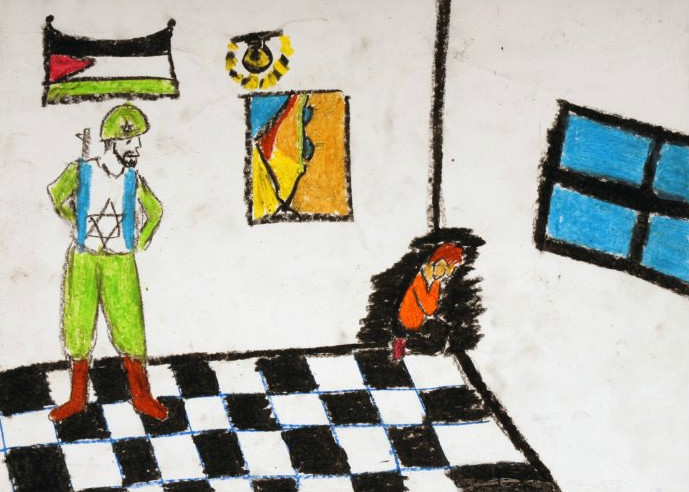
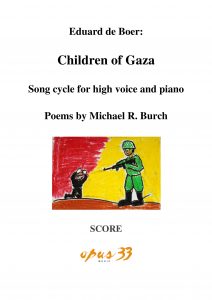 Text: Michael R. Burch
- Prologue. Where does the Butterfly go?
- The Raid
- For God’s Sake, I’m only a Child
- King of the World
- Mother’s Smile
- In the Shelter
- Frail Envelope of Flesh
- Among the Angels now
- Epilogue. I have a Dream
Composing this song cycle was made possible by Christoph Bouthillier and Nelly Bouthillier – Den Boer
Dedicated to the children of Gaza and their parents
The full text of the poems can be read and / or downloaded here, together with introductory background information: Children of Gaza – Introduction and Text of the Poems.
The full score may be copied, shared and distributed freely. It can be downloaded here for free: Children of Gaza – Partituur met Voorwerk. It will be appreciated if information about performances and / or recordings of this cycle or part thereof is sent to hallo[at]eduarddeboer.org[1]. And in 2025, I also wrote a version of this song cycle for soprano and orchestra.
[1] Please replace the [at] by @. This is to avoid spam attacks.
Youtube:
Dima Bawab, soprano; the composer, piano
In 1976, I was 19 years old when I spent my summer holidays in Israel. I worked for three weeks in a Kibbutz, then travelled one week through the country. I very much enjoyed those weeks and have many beautiful memories of them. However, contrary to the expectations I had at the time, my fondest memories today have to do with Palestinians rather than Israelis. For instance, I vividly remember that, during my weeks in the Kibbutz, I was ordered to join a group that worked on a sunflower field in a nearby village, supervised by an old Palestinian man. He turned out to be the friendliest, mildest and loveliest person I had ever met. And I also remember hitchhiking somewhere, with a large backpack on my shoulders and a big camera hanging around my neck, when someone shouted at me, inviting me to come into his house; which I did. Maybe it was a naïve thing to do, especially for someone who obviously looked as much like a young and vulnerable Western tourist as I did, but I never regretted it. I was welcomed by a group of very friendly Palestinians, who offered me food and drink, and even showed me where the key to the house was hidden, so I could enter it at any time, whenever I wished. I had never encountered such hospitality before. These experiences formed a contrast to what I had learned at the Christian schools I had attended, where I had been told that Arabs were stupid heathens and that it was a good thing that God had finally returned the ‘Holy Land’ to his ‘chosen people’.
I never returned to Israel, but I did develop a fondness for Jewish folk melodies, which I incorporated into some of my compositions, for instance in my first symphony and in my Yiddish Suite for cello and piano. (Recordings of these compositions can be found on YouTube, under my pseudonym Alexander Comitas.)
It was many years after my visit to this country, that my Belgian friend André Posman, at the time an organizer of classical concerts, made me aware of the plight of the Palestinians and the lack of attention by the mainstream media for their dire situation. He offered me a book about the situation in the Gaza Strip, a book that among other things contained some poems. Slowly the idea began to take shape in my mind ‘to do something’ with this, at some point in the future.
Again, years later, this idea had developed to the point that I wished to compose a song cycle about Palestinian children in Gaza. By then, the Internet had become commonplace, so I began searching it for poems having to do with this theme. In doing so, I came across the name of an American poet, Michael R. Burch, who on his website www.thehypertexts.com has for many years been campaigning very actively for the Palestinian cause. I found his e-mail address and in January 2016, I finally decided to contact him about the idea of a song cycle. By then, the idea of a ‘storyline’ had become rather clear. I envisaged a cycle with two consecutive climaxes, one where a child’s family is shot by Israeli soldiers during a raid, and later another one where a child is killed by a bomb dropped by an Israeli plane[1]. I also had found a number of Palestinian folk songs on YouTube and I had purchased a CD called Lost Songs of Palestine. In this way, I had acquired a small collection of songs to which I could allude.
And then a miracle happened, or rather: a series of miracles. Michael not only gave me permission to use any of his poems I wanted, but also offered to write any additional poems I needed for the cycle. Furthermore, I could feel free to instruct him not only about the subject of each poem, but also about its length, its meter and form, and about certain melodies I would like to use. He turned out to be just the ideal collaborator to make the wish of composing a cycle like this come true!
And it didn’t stop there. I had proposed to Michael to make it a project extending over several years. I earn my income mainly by composing in response to commissions and I intended to write one song at a time in between them. But then, in February, I received an e-mail from Nelly, the widow of Christoph, a dear friend of mine who had sadly died a few months earlier, informing me that in his will he had left me and my wife an amount of money. I asked her if she would allow me to regard this amount as a commission fee for a Children of Gaza song cycle, and she liked the idea, because Christoph was the type of person who always stood up against injustice.
And on top of all this, against my expectation, I couldn’t start with either of both composition commissions I had at this time: for one of them, a scenario still hadn’t been written and for the other one I needed a detailed account of the technical level of the members of the performing band. So, suddenly and unexpectedly, I had the collaboration of an ideal poet, the money necessary to write the cycle, and also an unexpected and perhaps provident amount of time!
Michael and I decided to go for it the cycle rapidly progressed, until 2½ months later we reached the point that it was ready. Luckily, inspiration came abundantly, and during the whole composing process I had the feeling that everything was just falling into place automatically. To give an example: the impact of the fatal bomb at the end of the song In the Shelter turned out to be exactly at the Golden Ratio point of the cycle as a whole; something I had neither expected nor influenced consciously in any way. The whole experience felt to me as if ‘it just had to be’.
The Palestinian folk songs that are quoted or alluded to in the cycle are:
– Al-Yadil Yadi (My Carefree Ways). This melody appears right at the opening of the first song and it returns at various places throughout the cycle.
– A so-called Dabka, a Palestinian folk song and dance, dealing with the occupation of Palestine in 1948. This theme, too, is heard for the first time in the first song, and it, too, returns a number of times, throughout the cycle.
– Mouvasha Lamma Bada Yathanna, an ancient song of lament. Merely hinted at in the song For God’s Sake, I’m only a Child, it is clearly alluded to in the songs In the Shelter and Among the Angels.
– Hala Layya, a lullaby. The beginning of this melody appears for the first time in the song Mother’s Smile, reappearing in In the Shelter and Among the Angels.
Happy as the story of this cycle’s creation is, the plight of the Palestinians living in Gaza and the West Bank is far from happy. No parent would allow his or her own children to be subject to the dire circumstances under which the children born there are living, and this alone ought to be enough reason for everyone to want to put an end to the atrocities that have been going on far too long in this troubled region. Everyone who has access to the Internet can now read about this, for instance on Michael Burch’s website www.thehypertexts.com (search for the terms ‘Palestine ‘or ‘Nakba’) or can watch videos, for instance on Facebook pages like The Eye of Palestine or The Palestinian Information Center. No ‘Holy Land’ or text in Bible or Torah can justify how Palestinian children are treated on their native soil.
Eduard de Boer, May 14th, 2016.
[1] The idea for both dramatic climaxes came from a number of poignant accounts on Michael Burch’s website
www.thehypertexts.com, (search for ‘Nakba Index‘, nakba being Arabic for catastrophe). See www.breakingthesilence.org.il, with testimonies by critical Israeli soldiers, for similar stories. A particularly poignant testimony by founder of the Palestina Medical Relief Society Mustafa Barghouti can be found on YouTube (www.youtube.com/watch?v=kDe_ZXOwWlU, search words Gaza Barghouti).